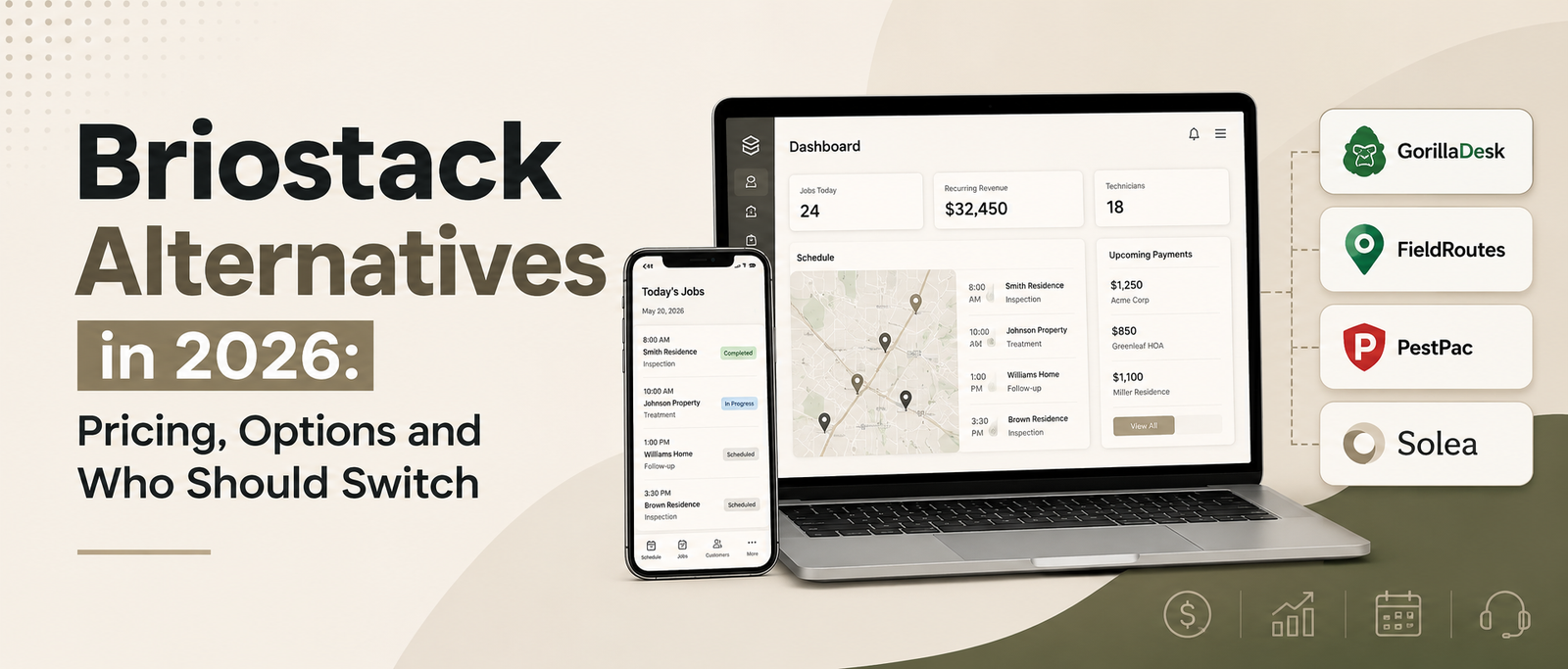
Nine sources publish a Briostack starting price and they disagree by a factor of more than thirty. That is the most useful fact available about Briostack pricing, and no comparison page currently reports it.
The reason is structural rather than sinister. Briostack sells through a demo, its pricing page returns an error, and software directories fill the gap with figures of varying provenance.
This article audits every published figure against its source. It then restores the review counts that ranking pages leave off, and ranks the alternatives by what happens to your office workload after a switch.
How much does Briostack cost?
Briostack does not publish pricing. Every public figure is a third party's estimate of a number the vendor discloses only during a demo.
Here is every published figure found, with its source and the date on the page.
| Published figure | Publisher | Date on page |
|---|---|---|
| $19 per month | SelectHub | 2025 analysis, live 2026 |
| $50 per month | Capterra | Updated 13 March 2026 |
| Around $50 per month | SoftwareAdvice Third-party sourced | Verified 18 July 2026 |
| Around $50 entry point | Autopilot comparison page | Updated July 2026 |
| $400 to $600 for 15 to 30 technicians | US Tech Automations | June 2026 |
| Custom quote, no public tiers | Contractor Software Hub | May 2026 |
| No price, pricing page returns 404 | PestGrade | Verified 18 July 2026 |
Why the published prices disagree
Two of these figures are measuring different things. The $19 and $50 numbers describe an entry point for a small operation, while the $400 to $600 figure describes a fifteen to thirty technician company with modules attached.
Neither is wrong. A buyer reading only one of them will budget incorrectly.
The 404 matters more than any single number. PestGrade checked the vendor's pricing page directly on 18 July 2026 and found it returned an error, with the homepage routing visitors to a demo request instead.
What you should budget
Ask for an itemised quote covering six lines: base platform, per-technician fees, SMS and communication charges, the marketing module, implementation, and training. Reviewers report discovering several of these after signing.
A quote that does not break those lines out is not a quote you can compare against anything. Request a twelve-month billing history if you are already a customer, because your current all-in cost is the only honest baseline for a comparison.
Who should stay on Briostack, and who should leave?
Stay if door-to-door canvassing drives your growth. Leave if your costs keep surfacing after signing, or if your constraint has moved from the route board to the phone.
What Briostack does well
Briostack splits into three modules. BrioOffice handles scheduling, routing, billing and customer management, BrioTech is the technician mobile app with offline support, and BrioSales covers sales territories, leaderboards and campaign tracking.
That third module is the honest case for staying. BrioSales has no equivalent built for pest control, and GorillaDesk, Jobber and Housecall Pro were not built for a canvassing team.
The recurring scheduling logic matters too. Recurring revenue accounted for 85.4% of residential service revenue in 2025 (NPMA, 2025), so software that handles quarterly cycles well is handling most of the money.
Satisfied customers are specific about why.
"We wish we had made the decision to switch to Briostack sooner."
An office manager writing in November 2025, in verified Briostack reviews on Capterra.
The complaints are equally specific. They cluster around cost disclosure and platform stability.
"Unfortunately most of what I liked about it ended up being an additional cost that I wasn't informed of or is too glitchy to be functional."
An owner of two years, in a one-star Capterra review from February 2026.
From Reddit
What operators actually say about Briostack on forums like r/PestControlIndustry
Briostack draws a split reaction from operators. One manager who moved to PestPac wrote that they wished they had stayed, calling Briostack "much more user friendly." A technician who moved the other way described the routing failing daily: "I could watch my boss personally schedule my route and the next day every time it would be jumbled into an inefficient way. Brio couldn't figure out how to fix it."
The ratings disagree, and review counts explain most of it
Ranking pages quote a Briostack rating without the denominator. Restoring it changes the reading.
| Rating | Reviews | Platform |
|---|---|---|
| 2.3 out of 5 | 7 | G2 |
| 2.4 out of 5 | 7 | Spotsaas |
| 3.7 out of 5 | 45 | Capterra Canada |
| 4.0 out of 5 | 71 | SoftwareAdvice |
| 4.1 out of 5 | 69 | Capterra |
| 80 sentiment score | 82 | SelectHub |
The two lowest ratings rest on seven reviews each. Every rating built on 45 reviews or more lands between 3.7 and 4.1.
There is a sharper signal underneath the averages. Capterra scores individual features, and its routing score sits at 3.3 from 23 reviewers (Capterra, 2026), the lowest of any feature it rates. Third-party reviews routinely describe routing as Briostack's headline strength, which is the opposite of what its own users score it.
What are the best Briostack alternatives in 2026?
Four alternatives are worth shortlisting, and the right one depends on whether your bottleneck is cost, marketing, compliance or office workload.
Most alternatives lists rank by feature count. This one ranks by what changes in your office after the switch, because that is the cost line deciding the economics. Three widely circulated Briostack alternatives lists include Jotform, NetSuite, Checkeden and Workvivo, none of which is pest control software.
| Platform | Published price | Office workload after switching | Best for |
|---|---|---|---|
| GorillaDesk | $49 to $149 per month | Unchanged | Under 10 technicians |
| FieldRoutes | Around $350 per month | Unchanged, better tooling | Marketing depth at scale |
| PestPac | $300 to $500, $1,200+ multi-branch | Unchanged, more reporting | Multi-branch compliance |
| Solea | Custom, demo required | Reduced, AI answers and schedules | Office is the bottleneck |
GorillaDesk
The cheapest credible move. GorillaDesk publishes pricing from $49 per month with a 14-day trial and no contracts, and holds 4.8 out of 5 from 277 Capterra reviews (PestGrade, 2026).
It has no door-to-door sales module and limited multi-branch support. For an operator under ten technicians who does not canvass, it is the strongest fit here.
FieldRoutes and PestPac
FieldRoutes runs around $350 a month and brings marketing automation Briostack does not match. PestPac carries the deepest compliance and multi-branch reporting in the category, from roughly $300 a month for smaller operations.
Both are built around human dispatchers and CSRs operating the software. Your office does the same work after the switch, with better tools. Our guide to pest control software ranked by price covers both in more detail.
Solea
The alternative for an operator whose daily bottleneck is inbound demand. AI employees answer calls, texts and web chats, book jobs into the live schedule, rebuild routes as jobs move, and follow up on quotes.
The distinction is architectural rather than featural. A platform built around AI employees sees the full customer record when it makes a decision. AI added to an older platform sees only what that platform chooses to expose.
We cover AI-native versus bolt-on architecture in full.
Solea is quoted per operation rather than published as a rate card, which puts it in the same position as Briostack on transparency. Model it against your office payroll rather than against a monthly software line.
Which pest control CRM is the best for FSM workflows?
It depends which part of the workflow is failing, and there are three different answers.
If routing is failing, the question is whether routes rebuild when jobs change or only when a person rebuilds them. PestPac's optimisation is built for scale, and this is the one area where staying may beat switching.
If compliance is failing, PestPac holds the deepest chemical tracking and state reporting in the category. Nothing else on this list matches it for multi-branch audit work.
If inbound calls are failing, no routing engine helps. Calls that go unanswered during peak season are lost jobs, and the fix is either more office staff or software that answers the phone. Our comparison of AI capability breaks down which platforms act on the customer record and which only surface suggestions.
For the underlying question of what a pest control CRM should hold, our complete guide to pest CRMs covers the fundamentals.
What breaks when you migrate off Briostack?
Four data objects habitually break in a pest control migration: chemical and application history, recurring service agreements, technician licence records, and stored payment credentials.
Post-cancellation record access is the one Briostack reviewers raise most often. SelectHub notes instances of users struggling to reach business records after discontinuing the service, which is a continuity problem rather than an inconvenience.
One Capterra reviewer reported receiving a collections notice for an alleged $26 balance more than a year after leaving, having never received an invoice for it.
What to get in writing before you sign
Get the cancellation terms and the data export format in writing before you commit to anything new. Ask what format chemical history exports in, and whether recurring agreements carry their original start dates across.
Ask for reference calls with two companies of your size and trade mix. A bimodal review pattern means outcomes depend on fit, so the experience of a company like yours predicts yours better than an average does.
The switching-trigger test
Four questions with thresholds attached.
- Is your constraint the route board or the phone? Routing improvements do not fix unanswered calls.
- Is door-to-door your primary acquisition channel? If yes, your switching cost is higher than any table shows.
- Can you state your all-in monthly cost from memory? If not, get an itemised history before comparing.
- What does your office cost you annually? Direct labour runs 26% of revenue industry-wide (NPMA and PCO Bookkeepers, 2025), and office labour sits outside that line.
The fourth question is the one operators skip. Dominique Stumpf, CAE, Chief Executive Officer of the National Pest Management Association, made the parallel point about technician turnover in PCT Online.
"You're losing productivity during the vacancy, spending time and money on recruitment, investing in training for the replacement."
The same hidden arithmetic applies to the office. Until it is measured, every software comparison runs on the wrong number.
Where should you start?
Start by pricing what you already have. Pull twelve months of Briostack invoices and total them, including SMS charges, module fees and implementation costs that were billed separately.
Then price your office. Count the hours your staff spend answering phones, booking jobs and rebuilding the schedule, and multiply by loaded hourly cost. That number rarely appears in a software comparison, and it is usually larger than the subscription being argued over.
Only then run the shortlist, and run it against those two numbers rather than against a feature grid. A platform that costs $100 more a month and absorbs half a salary is cheaper than the one you have.
If your route board works and your phones are what fail during peak season, that is a different problem from the one a new CRM solves. Adding a better scheduling engine to an office that cannot pick up the phone changes little.



 Overnight