AI pest control software splits into two camps today, first platforms that bolt AI features onto legacy systems, and the second platforms built AI-native from the ground up. This guide explains the difference, why it decides what happens to your office payroll as you grow, and which type of system fits a scaling operation.
What is AI-native pest control software?
AI-native software assumes AI agents are the primary actors. The data model, the integrations, and the interface are all designed around autonomous agents owning end-to-end processes, with humans supervising rather than executing.
That distinction sounds academic until you watch it play out across a peak-season Monday in a 30-truck operation. So let's make it concrete.
AI-native pest control software is built so AI agents perform the operational work directly, making and executing decisions rather than suggesting actions for a human to carry out. The defining test is architectural: the AI is the operator, and the human handles exceptions.
Bolt-on software inverts that relationship
The human is still the operator, and the AI is a feature that helps them move faster inside a conventional interface.
This is not about whether a product "uses AI."
By 2026, nearly every pest control CRM runs a large language model somewhere, whether a chatbot, a call summary, or a predictive report. Using an LLM is not the same as being AI-native.
The smartphone is the cleanest analogy.
Adding a touchscreen to a flip phone did not make it a smartphone. The smartphone was a different architecture, built around apps and connectivity from the silicon up. AI-native software is the same kind of shift, where the AI is the workflow rather than a feature on top of it.
AI-native vs. bolt-on AI in pest control software: what's the difference?
The practical difference between AI-native vs. bolt-on AI comes down to who does the work and how the parts connect. Bolt-on AI adds isolated smart features onto a platform whose data model was designed for humans. AI-native software runs every function through coordinated agents on a single shared substrate.
The first makes a human faster at one task. The second removes the task from the human's plate and hands the output to the next agent automatically.
Here is how the two architectures compare across the dimensions that affect a growing operation:
| Dimension | Bolt-On AI (legacy plus AI features) | AI-Native |
|---|---|---|
| Who does the work | Human operates the software, AI assists | AI agents do the work, human supervises exceptions |
| Data model | Built for human workflows, AI sees only what the integration exposes | Built for agents, every agent shares the same live customer state |
| Adding a new AI capability | New integration or module bolted on | Native agent on the existing substrate |
| Cross-function handoff | Lost or manual across separate tools | Automatic, agents share context |
| Vendor footprint | Often multiple point tools stitched together | Single platform, single update cycle |
| Update and version drift | Each integration updates on its own schedule | One system, one release |
| Office labor as you scale | Grows roughly with volume | Decouples from volume |
| Best fit | Shops digitizing a paper operation | Operations scaling past proportional office hiring |
The pattern is consistent. Bolt-on architectures optimize individual tasks. AI-native architectures optimize the entire operation as one connected system.
That connected system is the part you cannot bolt your way to.
Why does bolt-on AI break at scale in pest control operations?
Bolt-on AI breaks at scale because each added feature sits on a data model that was never designed for autonomous agents. That creates three compounding failure modes. A small operation rarely feels them. A multi-branch operation running tens of thousands of jobs a year feels all three, and they worsen as volume grows.
The three failure modes, in order of how much they cost you:
1. Integration lag
When an AI receptionist from one vendor books a job, that booking has to travel through an integration before the scheduler can act on it. During peak season, when calls cluster and routes shift hourly, even a short sync delay means the scheduler is optimizing against a stale picture of the day.
2. Data silos
Bolt-on stacks are usually assembled from several products: an answering service, a routing optimizer, a review tool, an email platform. Each holds its own slice of the customer, so the answering AI does not know about last August's German cockroach treatment and the routing AI does not know the technician's WDO certification lives in the CRM. Every silo is a place where context dies, and context is what makes AI decisions good instead of generic.
3. Version drift
Each bolt-on tool updates on its own schedule, so a change in one vendor's API can quietly break a workflow in another. The operator becomes an unpaid systems integrator, managing five contracts, five support queues, and five roadmaps that were never built to move together.
The cost of these failures scales with you. For an owner running 5 trucks they are an annoyance. For an operations director running 50 across four branches, they are a standing tax on every process.
These are not edge cases. They are the predictable result of assembling an operation from parts architected separately.
How do AI agents for pest control work together?
AI agents work together by sharing one live customer record and handing work off automatically, so the output of one agent becomes the input of the next with no human or integration in between. The customer is captured once, and every action after that operates on the same continuously updated picture.
This is the advantage bolt-on stacks cannot copy, because their context is fragmented across separate systems by design.
Here is how Solea's four agents pass work to each other on a single substrate:
AI CSR
AI CSR answers inbound calls, texts, and web chats 24/7, books and reschedules jobs, and quotes pricing in a natural conversation. The moment it books a job, the customer record is live for every other agent, with no export, sync, or integration.
AI Scheduler
AI scheduler sees that booking instantly and builds it into the day's routes, assigning the best-fit technician by certification and rebuilding routes in real time when a cancellation hits. Because it shares state with the CSR, it never optimizes against a stale schedule.
AI Coach
AI Coach reviews the recordings of calls the CSR and human reps handle, scores performance, and surfaces what is and is not converting. It sees the booking and the outcome on the same record, so its feedback is grounded in what actually happened to the job.
AI Sales Rep
AI sales rep follows up on quotes that did not close, contracts approaching renewal, and seasonal upsells triggered by rising pest pressure, referencing the same service history the CSR captured at first touch. A follow-up that names last August's treatment and the warranty expiring next month converts. A generic "we miss you" does not.
The handoff is the product. In a bolt-on stack, every handoff is an integration that can lag, drop context, or break. In an AI-native system, there are no handoffs to break, because it is one system.
What does end-to-end AI pest control software deliver?
End-to-end AI delivers measurable gains in office capacity, payroll, and revenue because the savings compound across functions instead of staying trapped in one. When the same connected system captures demand, schedules it, follows up on it, and coaches the people involved, efficiency at each step reinforces the next.
Operators running Solea's AI-native platform report the following outcomes:
| Outcome | Reported result | Where it comes from |
|---|---|---|
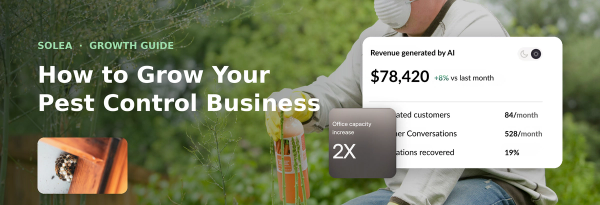
| Office capacity | 2x increase | AI agents absorb routine calls, scheduling, and follow-up |
| Payroll savings | $80,000+ average annual | Office headcount decoupled from job volume |
| Revenue uplift | ~12% average attributed to AI | Captured after-hours demand, faster follow-up, systematic upselling |
| Customer service and dispatch costs | Up to 82% savings | Automated after-hours call handling and routine scheduling |
Read those numbers as a system, not a menu. The 82% reduction in customer service and dispatch cost is not the AI CSR working alone. It is the CSR capturing the call, the Scheduler placing it without a dispatcher, and the Coach holding quality without a manager listening to every recording.
A bolt-on stack can chase any one of these numbers with a point solution. It struggles to compound them, because the savings live in separate systems that do not reinforce each other.
An integrated system has fewer seams for errors to hide in, which means fewer operational bugs and cleaner pest control on the ground.
What is the real cost of bolt-on AI pest control software?
The real cost of bolt-on AI is not the subscription line, it is the integration tax. That tax is the engineering, support, and management overhead of keeping multiple tools working together, plus the revenue lost in the gaps between them.
The sticker price of five point tools can look competitive next to one platform. The total cost of ownership rarely is, once you account for what the operator has to do to make the parts behave.
The integration tax shows up in three places:
Integration and maintenance
Someone has to build, monitor, and repair the connections between tools, and that someone is usually the operations lead whose time is the scarcest resource you have.
Vendor management
Five contracts, five renewal cycles, five support queues, and five roadmaps that can diverge at any time.
Leakage between systems
The after-hours call the answering tool captured but the scheduler could not act on until morning. The upsell the CRM knew about but the follow-up tool never triggered. These gaps are invisible on an invoice and expensive on a P&L.
An AI-native platform collapses that tax. One vendor, one data model, one update cycle, one support relationship, and no gaps between systems for revenue to leak through, because there are no separate systems.
For a small shop, the integration tax is small enough to ignore. For a medium-to-large operation, it is often the single largest hidden cost in the software stack, and in a tightening margin environment it is exactly the cost that bolt-on pricing pages never show.
Which pest control companies should choose AI-native software?
AI-native software is the right choice for operations that have outgrown proportional office hiring, typically multi-truck companies scaling past the point where adding revenue means adding CSRs and dispatchers. When growth keeps adding office cost, the office itself becomes the constraint. It is not the right first move for a one or two person shop digitizing off paper, and there are good, inexpensive tools for that operator.
The value of AI-native architecture scales with complexity. The more demand, branches, certifications, and after-hours volume an operation handles, the more the integrated model returns.
Use this framing to place your own operation:
| Operation profile | What you likely need | Why |
|---|---|---|
| 1 to 3 trucks, simple residential, paper-to-digital | Affordable, simple software | Integration tax is negligible, AI ROI is thin at this volume |
| 5 to 15 trucks, growing, high inbound call volume | AI-native, starting with call capture | Missed after-hours demand and office labor are the binding constraints |
| 15 to 50+ trucks, multi-branch, mixed residential and commercial | AI-native, end-to-end | Coordination across branches and certifications is where bolt-on stacks break |
| Enterprise, audit-heavy compliance | AI-native with deep compliance | Needs autonomous operations and audit-ready records on one system |
Notice what this is not. It is not the cheapest tool for the smallest shop. Solea is built for operators with advanced needs: high call volume, multiple branches, certification-driven dispatch, and recurring-revenue motions, who want to scale revenue without scaling office headcount in lockstep.
If you are choosing software primarily on lowest monthly price, you are not the operation this architecture is built for, and that is a fair filter to apply early.
The honest buying question is not "which tool has AI." It is "which architecture lets my operation grow without my office growing with it."
Frequently asked questions
What is the difference between AI-native and AI-assisted pest control software?
AI-assisted (bolt-on) software adds AI features like chatbots, routing suggestions, and call summaries on top of a platform built for human operators, where a person still does most of the work. AI-native software is architected so AI agents do the work directly and humans supervise exceptions. The practical difference is whether your office labor grows with your job volume or stays flat as you scale.
Is FieldRoutes or PestPac AI-native?
No. FieldRoutes and PestPac are mature field service platforms that added AI features over time, which makes them AI-assisted rather than AI-native. Their core architecture was designed around human dispatchers and CSRs operating the software, so their AI augments human workflows rather than replacing them. AI-native platforms take the opposite approach, building the system around agents that do the work directly, and purpose-built AI-native platforms like Solea AI exist for pest control specifically.
Does using an LLM make software AI-native?
No. Nearly every modern pest control CRM uses a large language model somewhere. AI-native is about architecture, specifically whether AI agents are the primary actors on a shared data model, not the mere presence of a model.
Will AI-native pest control software work for a small operation?
It can, but it is usually not the best first move for a one or two truck shop digitizing off paper, where a simple low-cost tool delivers more value than autonomous AI. AI-native architecture returns the most for operations with enough call volume, branches, and complexity that office labor and missed demand have become real constraints, typically 5 or more trucks and growing.