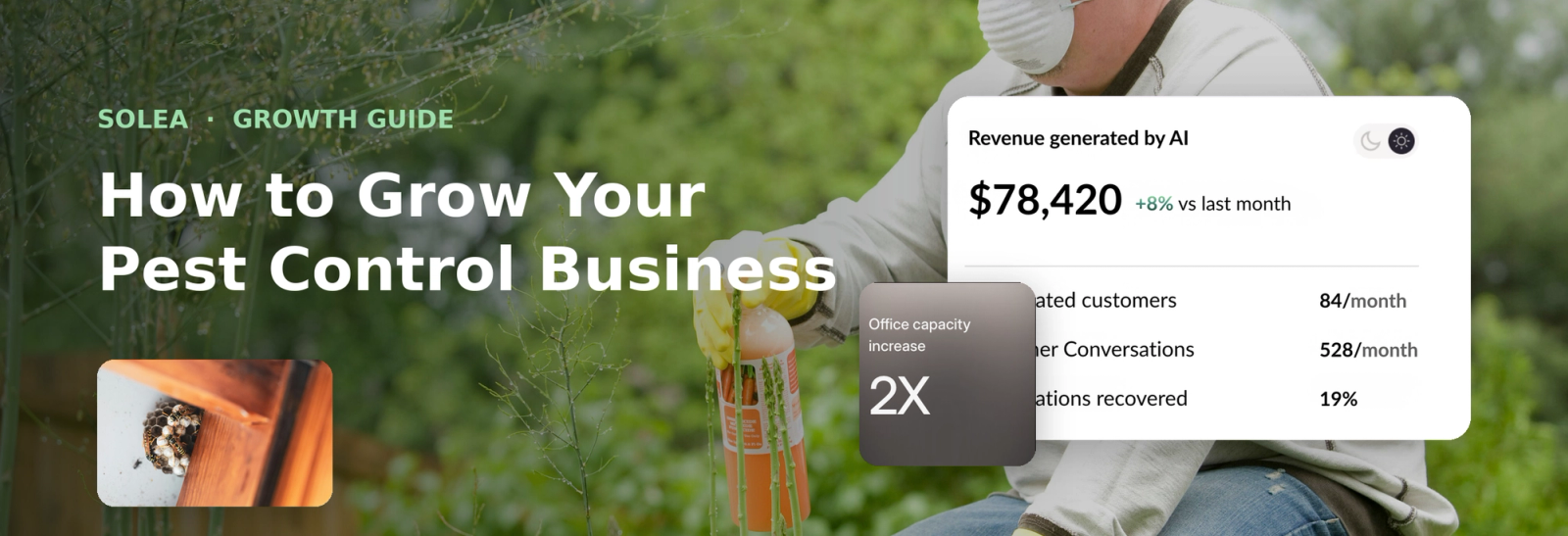
Figuring out how to grow a pest control business in 2026 starts with an uncomfortable audit: most companies lose more revenue to missed calls, unconverted one-time jobs, and loose routes than they gain from new marketing.
The growth advice published by software vendors and agencies focuses almost entirely on demand generation and skips the capacity problems that stall companies once demand arrives.
This guide covers 15 strategies across demand capture, retention, pricing, operations, and AI. Each one states the numbers behind it, links the source, and ends with a pro tip you can act on this week.
15 Strategies to Grow Your Pest Control Business
1. Stop losing the customers who already call you
Before spending another dollar on ads, fix your answer rate. A 2024 study by 411 Locals across 85 businesses in 58 industries found only 37.8% of calls are answered by a live person, and 25% of pest control sales calls arrive after hours or on weekends, per Slingshot data reported by Pest Control Technology.
Most callers who reach voicemail hang up and dial the next company. Industry analysis puts the cost at $26,000 to $39,000 per year for a five-truck operation missing a quarter of its calls.
2. Convert one-time customers into recurring pest control plans
Every one-time job is a recurring plan that has not been offered yet. According to industry insights, one-time customers convert to recurring plans at 60 to 70% when the offer is made well, at roughly $400 per year per recurring customer, and recurring books smooth the seasonal cash-flow swings that stall growth.
Build the offer into the visit itself, using the pest pressure the technician found as the reason for ongoing service.
Still sending after-hours callers to voicemail? See how
Solea's AI receptionist answers, qualifies, and books them into your real schedule while your competitors sleep.
3. Automate pest control customer follow-ups with AI
Follow-up is where pest companies leak the most winnable revenue, because acquiring a new customer costs 5 to 25 times more than retaining one. Customer acquisition costs in pest control averaged $63 per customer as far back as 2023, and the hidden math behind pest control customer acquisition cost shows the office workload behind that number.
Automate three sequences: unsold quotes, lapsed customers, and post-service check-ins. AI tools now write, send, and respond to these across text and email, so follow-up happens even when the office is slammed in July.
4. Win the review race before the ad race
Reviews are the cheapest ranking factor in local search and the first thing homeowners check. Ask for the review at the moment of proof, right after the technician resolves the problem.
Assign review requests to your workflow, not your memory. Companies that automate the ask after every completed job accumulate reviews at a pace manual competitors cannot match, and prospects read your responses to bad reviews as closely as the reviews themselves.
5. Get more pest control customers with Local Services Ads
Local Services Ads put your company at the top of Google with a Google Guaranteed badge, and you pay per lead instead of per click. For urgent searches like "exterminator near me," LSAs capture the caller before organic results load.
Two rules make them profitable: answer live, and audit your leads.
6. Build a referral engine with real incentives
Referrals convert at higher rates than any paid channel because trust arrives with the lead. Most pest companies treat referrals passively and collect only what falls in their lap.
Promote the program in post-service emails, invoices, and technician conversations, and track referral sources in your pest control CRM so you know which customers to thank.
7. Add commercial pest control accounts
Commercial accounts change the math of growth. Property managers and business accounts sign monthly contracts of $100 to $500 with lower cancellation rates according to industry reports, compared to residential customers at $35 to $75 who switch providers more often.
Start with the commercial niches that need you by regulation: restaurants, food processing, healthcare, and multi-family housing.
8. Price for margin, not market share
Underpricing is the most common self-inflicted growth ceiling in pest control. Reports suggest, operators charging $40 to $50 per month attract customers who value reliability, while competing at $25 to $30 attracts bargain hunters who churn.
Best-in-class pest companies run gross margins of 55 to 57%. If your margin sits well below that while costs climb, the 2026 margin squeeze will do your pricing for you, in the wrong direction.
9. Increase pest control revenue with targeted add-on services
Your existing customers are the cheapest source of new revenue. Termite inspections, mosquito treatments, rodent exclusion, and attic sanitation all sell best to households that already trust your technician.
Sell from evidence, not scripts, and track attachment rate per technician so you can coach to it.
10. Raise revenue per technician with route density
A truck that drives less and services more is growth without new payroll. Route optimization pays measurably: a Forrester study of field service software deployments, commissioned by Microsoft, found technician productivity rose up to 14% after full implementation, with $2.1 million in three-year travel-time savings at the modeled organization.
Pest control route optimization software handles the sequencing, but density is a sales decision first.
11. Choose pest control business software that removes office work
The right pest control business software is the one that cuts hours from your office, not the one with the longest feature list. Evaluate on three tests: does it automate scheduling and routing, does it handle billing and chemical compliance without spreadsheets, and does its mobile pest control app work for technicians in the field, including offline.
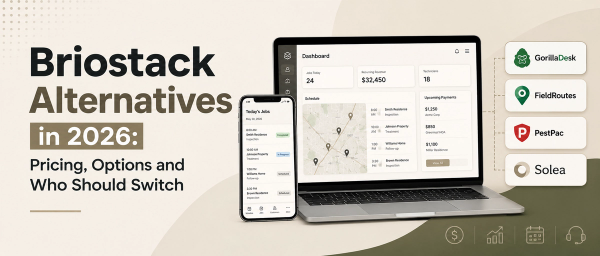
Our complete guide to CRM for pest control companies covers the selection process, and the Solea vs PestPac vs FieldRoutes comparison covers ratings, pricing, and fit by size.
12. Scale a pest control business without hiring more office staff
The traditional growth path adds a CSR or dispatcher for every few trucks, which means every growth spurt buys a salary before it earns a profit. The alternative is to automate the office roles that scale worst: phone answering, scheduling, rescheduling, and follow-up.
For many 3 to 10 truck companies, the office bottleneck breaks before the technician bottleneck does.
13. Use AI to grow a pest control business
AI in pest control now does jobs, not demos. AI receptionists answer, qualify, and book calls at any hour. AI schedulers build technician routes and re-optimize them when jobs cancel or run long. AI follow-up agents chase unsold quotes and lapsed customers automatically.
The market offers two paths, and the difference matters: AI-native vs bolt-on pest control software explains it in depth. Add-ons suit companies happy with their current software. AI-native platforms like Solea suit owners who want the office itself automated.
Spending your afternoons reworking the route board? See how
Solea's AI scheduler rebuilds routes on its own when jobs cancel, move, or run long.
14. Track the four numbers that predict growth
Growth compounds when you manage it by numbers instead of feel. Industry benchmarking by PCO Bookkeepers with the NPMA identifies gross margin, with a best-in-class range of 55 to 57%, and adjusted EBITDA, with a target of 20% or higher, as the core health metrics.
Add two operational numbers: revenue per technician and monthly cancellation rate.
15. Sell the slow season instead of surviving it
Winter revenue dips are a planning failure, not a law of nature. Pest pressure changes in cold months; it does not disappear.
Build a cold-season offer list: rodent exclusion, overwintering pest prevention, crawl space and attic inspections, and termite monitoring renewals.
Pest Control Business Growth Strategies: Where Should You Start?
Start with the strategy that recovers revenue you already paid to generate, then work outward. Week one, pull 30 days of phone logs and count missed calls; fixing answer rate is the highest-return move on this list and needs no new marketing spend. Weeks two and three, launch the recurring-plan offer and one automated follow-up sequence, since both monetize customers already in your system.
Week four, run the office-hours math from strategy 12 and decide your capacity model before peak season decides it for you. Companies that handle demand capture, retention, and capacity in that order enter the next season compounding, while companies that start with ad spend pour new leads into the same leaks.
FAQs
How profitable is a pest control business?
Pest control supports profit margins of 10 to 30% on services and established owners commonly earn $110,000 to $160,000 per year with efficient operations. New operations typically reach break-even at 75 to 100 recurring customers, often within months 6 to 9.
What is the best pest control software for growing companies?
The best pest control software depends on who will operate it. FieldRoutes and PestPac suit companies with office staff to run them, GorillaDesk and Jobber suit small teams managing manually, and Solea suits owners who want AI handling calls and scheduling.
How do pest control companies get most of their new customers?
Referrals close at over 50%, compared to under 20% for ad-driven leads and 20 to 30% overall for home service contractors). Established companies grow their base on referrals and reviews first, then use paid channels like LSAs to fill route gaps, since paid leads cost more and convert worse than warm ones.
What is real-time dispatch in pest control?
Real-time dispatch means the schedule updates itself during the workday: when a job cancels, runs long, or gets added, routes are re-sequenced automatically instead of waiting for a dispatcher to rework the board. It differs from standard route optimization, which builds an efficient plan each morning and leaves same-day changes to a human. The distinction matters most in peak season, when a single cancelled stop can strand 45 minutes of technician time.
 Overnight